
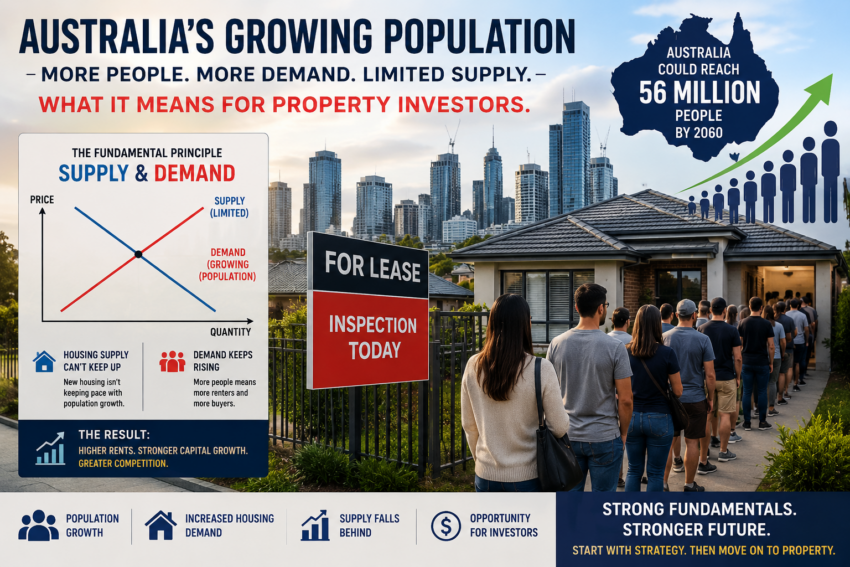
Principle of Supply vs Demand : If Australia’s Population reaches 56 million – what does this mean for Investors?
Australia’s population is growing, housing supply is struggling to keep pace, and the gap between the two could have profound implications for rents, property prices and property investors.
Australia has a population problem.
But perhaps not the problem many people think.
The real issue is not necessarily that Australia is growing too quickly. It is “whether Australia can build enough of the right housing, in the right locations and at the right time to accommodate that growth !”
A recent discussion about the possibility of Australia eventually reaching a population of 56 million raises an important question for anyone involved in property:
Where will all those people live?
For property investors, this is not simply a demographic question.
It is a question of housing demand, rental demand, supply, affordability and ultimately the long-term fundamentals underpinning property values.
Australia already has almost 28 million people. According to the Australian Bureau of Statistics, the nation’s population reached 27.8 million at 31 December 2025, after increasing by approximately 412,500 people during the preceding 12 months.
Net overseas migration accounted for approximately 301,000 of that increase.
At the same time, Australia is struggling to build enough homes.
That creates an important structural imbalance.
And whenever demand for accommodation continues to grow faster than supply, the pressure eventually shows up somewhere = through higher rents, higher property prices, smaller dwellings, greater competition for accommodation or increased housing stress.
For property investors, understanding that relationship is becoming increasingly important.
Australia’s Population Is Still Growing
Australia’s population was 27.8 million at the end of 2025, according to the ABS.
That represented annual growth of 1.5 per cent, or more than 400,000 additional people in a single year.
Western Australia recorded the fastest population growth among the states at 2.2%, while Victoria grew by 1.7% and Queensland by 1.6 per cent.
The important point is not simply the headline population number.
It is the continuing addition of people requiring somewhere to live.
Every additional resident does not automatically require an additional house. People live together, share accommodation and occupy existing dwellings.
However, population growth contributes to household formation, and household formation creates demand for housing in the short, medium and long term.
That distinction is critical.
The Bigger Question: “Where Will They Live?”
Australia’s population debate often focuses on how many people the country should have.
For property investors, the more relevant question is: “Where will those people live?“
If Australia’s population continues to grow strongly while housing construction remains constrained, there are only a limited number of ways the market can respond.
We can:
- build more homes
- build higher-density housing
- utilise existing housing more efficiently
- increase the size of households
- expand existing cities
- develop new growth corridors
- move more people into regional centres
- or accept increasing competition for existing accommodation.
The market will ultimately find a way to allocate scarce housing.
But that allocation comes at a price.
Construction Costs continue to escalate, land developer costs continue to escalate … result is buyers paying more tomorrow for the same of today, renters paying more rent than they are today.
As an Investor, your opportunity to maximise on Capital Growth Potential + healthy rental yields.
Population Growth + Housing Shortage = Increasing Housing Pressure
This is where the issue becomes particularly important for property investors.
Australia has a national target of 1.2 million new homes over five years to June 2029 under the National Housing Accord.
The target sounds enormous.
But consider what it actually means.
It requires Australia to deliver an average of approximately 240,000 homes a year.
And the evidence suggests we are struggling to achieve that rate, with the demand supply gap widening.
The National Housing Supply and Affordability Council reported that only 177,000 new dwellings were completed in 2024, compared with estimated underlying demand of approximately 223,000.
Its 2025 modelling forecast approximately 938,000 new dwellings over the five-year Housing Accord period – around 262,000 below the 1.2 million target.
More recent 2026 modelling has improved that outlook somewhat, but the Council still expects the 1.2 million target to be reached later than the original June 2029 deadline.
Meanwhile, construction is being constrained by:
- labour shortages
- construction costs
- financing costs
- planning and approval processes
- builder capacity
- apartment development challenges
- land availability
- infrastructure constraints
- and builder insolvencies.
The result is straightforward.
Australia is attempting to accommodate population growth while its ability (inability) to increase housing supply is constrained.
That is a recipe for continued housing pressure.
Why Housing Supply Matters So Much to Property Investors
Property markets are ultimately driven by supply and demand.
When supply can comfortably accommodate demand, price and rental pressures can remain relatively contained.
But when demand continues to increase while supply is constrained, competition for available accommodation increases.
That competition can manifest itself through:
Higher rents
When tenants compete for a limited number of suitable properties, rental prices can rise.
Higher property prices
When more buyers compete for a limited supply of desirable properties, prices can come under upward pressure.
Lower affordability
As both rents and property values increase faster than incomes, housing becomes less affordable.
Greater demand for alternative forms of housing
When traditional detached housing becomes increasingly expensive, demand can shift towards townhouses, apartments, dual-key accommodation, Co-Living and other forms of higher-density housing.
For investors, these changes create both opportunities and risks.
It Is Not Simply About Population Growth
It would be too simplistic to say:
“More people means property prices will automatically rise.”
Yet, historically, property markets are influenced by many factors, including:
- interest rates
- lending policy
- household incomes
- employment
- taxation
- government policy
- construction costs
- investor participation
- consumer confidence
- land availability
- infrastructure
- planning restrictions
- local housing supply
- and the type of properties being built.
Population growth creates underlying demand.
Whether that demand ultimately translates into higher rents and higher property values depends heavily on where that population growth occurs and whether sufficient housing can be supplied. Currently in population growth locations, Australia wide, supply is not being sufficiently met … the result remains strong dwelling prices and healthier rental yields.
This is why location and property selection matter so much.
Household Formation Is Just as Important as Population Growth
There is another part of the housing equation that is often overlooked.
You do not simply need to count people.
You need to consider households.
Australia’s population can increase without housing demand increasing on a one-for-one basis.
But the reverse is also true.
If the average number of people living in each household declines, Australia can require substantially more dwellings even without extraordinary population growth.
People live alone.
Couples separate or a spouse passes on.
Children leave home.
Older Australians downsize.
Young professionals seek independent accommodation.
Students require accommodation.
Workers relocate for employment.
Families change shape.
These demographic and social trends all influence housing demand.
This is one reason why the property investment equation is considerably more complicated than simply comparing population numbers with the number of houses.
Australia’s Demographics Are Changing – And So Will Its Housing Requirements
Australia is not just becoming more populous.
It is also becoming older.
The Australian Government’s Intergenerational Report projects that Australia’s population will continue to age substantially over the coming decades.
The number of Australians aged 65 and over is projected to more than double over the 40-year period covered by the report.
That will influence the type of housing Australia requires.
An ageing population creates demand for different forms of accommodation, including:
- smaller, lower-maintenance homes
- apartments
- townhouses
- Co-Living
- Multi-Generational housing solutions
- retirement living
- accessible housing
- specialist accommodation
- housing close to healthcare
- housing close to public transport and services.
At the other end of the demographic spectrum, younger workers, students and newly arrived Australians can create strong demand for affordable and flexible rental accommodation and suited housing solutions.
This means Australia’s future housing challenge is not simply:
“How many houses do we need?”
It is:
“What types of homes will Australians need, and where will they need them?”
Australia Will Need More Than Detached Houses
This is where the future of Australian property becomes particularly interesting.
Australia has traditionally been dominated by the detached house.
But as land and housing become more expensive, and as populations become more concentrated around employment and infrastructure, a broader range of housing solutions will become increasingly important.
Australia will need:
- detached homes
- townhouses
- apartments
- smaller dwellings
- build-to-rent
- Co-Living
- student accommodation
- retirement accommodation
- specialist disability accommodation
- social and affordable housing
- dual-key accommodation
- and other innovative housing models.
For property investors, this creates an important lesson.
The property of the future may not necessarily look like the property of the past.
Population Growth Will Not Be Evenly Distributed Across Australia
Australia’s population does not grow evenly.
Some locations attract substantially more people because of:
- employment
- infrastructure
- affordability
- lifestyle
- education
- healthcare
- transport
- migration patterns
- industry investment
- and government development strategies.
The latest ABS data shows that capital cities continued to account for a substantial share of Australia’s population growth, while individual cities and regions experienced very different rates of expansion.
This is why investors should not simply look at:
“Is Australia’s population growing?”
They should be asking:
“Where is the population growing?”
And then:
“Is housing supply keeping up with that growth?”
And finally:
“What infrastructure and employment will support that population in the future?”
That is a much more meaningful investment analysis.
Follow the Infrastructure, Not Just the Population
One of the most important principles for property investors is that population growth by itself, as important a factor it is, is not enough.
A location can experience population growth without necessarily producing outstanding investment returns.
The strongest investment opportunities can occur where several fundamentals come together.
For example:
Population growth + employment growth + infrastructure investment + constrained housing supply + affordability = potentially powerful housing demand.
This is why major infrastructure projects matter.
New roads.
Rail extensions.
Hospitals.
Universities.
Employment precincts.
Shopping centres.
Industrial developments.
Airports.
Transport corridors.
New schools.
These investments can make locations more attractive to residents and businesses.
They can also influence where future population growth occurs.
What Does All This Mean for Property Investors?
For investors, the implications are significant.
If Australia continues to experience population growth while housing construction struggles to keep pace, the underlying demand for accommodation should remain substantial.
That does not mean every property will perform well.
In fact, it makes property selection even more important.
Investors should be looking for properties with characteristics that are likely to remain attractive to future tenants and owner-occupiers.
This includes considering:
Population growth
Is the local population growing?
Employment
Are there jobs being created locally?
Infrastructure
Is significant infrastructure being planned or delivered?
Housing supply
How much competing housing is likely to enter the market?
Rental demand
Are tenants competing for suitable properties?
Affordability
Can local households afford the type of property being purchased?
Location
Is the property close to employment, transport, education, healthcare and essential services?
Property scarcity
Is the type of property readily available, or is supply constrained?
Land component
Does the investment have an appropriate underlying land component for its location and strategy?
Tenant appeal
Will the property remain attractive to tenants five, ten or fifteen years from now?
These are the questions that separate investment property from simply property that happens to be available for purchase.
Why Investment Grade Property Matters More in a Supply-Constrained Market
At properT network, we believe the starting point should always be the investment strategy, not the property. Your budget, investment-grade dwelling type and chosen location then need to be matched to the purpose of the investment – why you are investing, the strategy you are following and, ultimately, the results you want to achieve. The property should be selected to support the investor’s objectives, rather than the investment strategy being forced to fit a particular property.
The market is fully aware that a rising tide does not necessarily lift every property equally.
Some properties will benefit from population growth much more than others.
An investor purchasing an older property in a location with weak employment, poor infrastructure and significant competing supply should not assume that Australia’s population growth will rescue the investment.
Conversely, a well-located investment-grade property in an area experiencing sustained population growth, employment expansion and infrastructure investment can have a much stronger underlying demand profile.
This is why property investors need to think beyond:
“What can I afford?”
and instead ask:
“What property, suited to my budget and purpose for the investment is most likely to perform the job I need it to perform?”
The investment objective might be:
- capital growth
- rental yield
- cash flow
- tax effectiveness
- diversification
- SMSF investment
- long-term wealth creation
- or a combination of these.
The property needs to match the strategy.
Start with strategy. Then move on to property.
The Rental Market Could Be Just as Important as Property Prices
Population growth does not only affect people wanting to buy homes.
It affects renters.
And this is particularly important because not everyone arriving in Australia, changing jobs, forming a new household or moving interstate will immediately become a homeowner.
Many will rent first.
Some will rent for years.
Others may remain long-term renters.
If housing supply cannot keep pace with rental demand, rental competition can remain elevated.
The National Housing Supply and Affordability Council’s 2026 report noted that the share of median household income required to pay the rent under a new lease had reached an all-time high of 33 per cent.
That is a significant indicator of the pressure already being experienced in the rental market.
For investors, rental demand therefore deserves just as much attention as potential capital growth.
The Housing Shortage Could Become a Long-Term Structural Issue
Housing shortages are sometimes described as though they are temporary.
But Australia’s challenge may be more structural.
If it takes years to:
- release land
- approve developments
- install infrastructure
- obtain finance
- secure labour
- build homes
- and establish new communities,
… then a shortfall in one year cannot necessarily be corrected the following year.Ocuring right now in Australia.
And that creates a cumulative effect Australia is experiencing now and into foreseeable future. [your investment opportunity]
If Australia requires approximately 240,000 homes a year to meet a target but consistently delivers substantially fewer, the difference does not simply disappear.
It becomes part of the existing housing shortage, whilst population continues to grow both naturally and through immigration..
And that is why housing supply deserves to be considered as a long-term investment fundamental, rather than merely a political talking point.
Could Australia Really Reach 56 Million People?
The 56-million figure should be treated carefully.
It is not the current official central population projection from the Australian Government.
For example, the 2023 Intergenerational Report projected Australia’s population to reach approximately 40.5 million by 2062–63.
The ABS’s current projection series also produces a range of outcomes depending on assumptions around fertility, mortality and migration.
So the purpose of considering 56 million should not be to suggest that Australia is guaranteed to reach that number.
Instead, it raises a more important question:
“What happens if Australia’s population continues growing substantially faster than the housing system’s ability to accommodate it?” A significantly valid question.
That is the question investors should be thinking about.
Because even before Australia reaches 40 million – let alone 56 million – the housing market is already experiencing significant supply and affordability pressures.
Australia’s Future Population Is Also a Property Investment Story
Population projections can sometimes seem abstract.
Twenty million.
Thirty million.
Forty million.
Fifty-six million.
But behind every population number is a person.
And behind those people are households.
Households need somewhere to live.
They need somewhere to rent or somewhere to buy.
They need access to employment.
They need schools.
They need hospitals.
They need roads and public transport.
They need shops and services.
They need communities.
Primary reasons why population growth is such an important long-term consideration for property investors.
The question is not whether every additional person will push up property prices.
The question is whether “housing supply can consistently keep pace with the number of people and households requiring accommodation.“ … so far not !
If it cannot, competition for well-located housing is likely to remain strong.
What Should Property Investors Be Looking For?
Australia’s population story reinforces a fundamental principle of property investment:
Do not simply buy property. Invest strategically.
Hey, anyone can buy a property – but very few know how to identify what makes for an Investment Grade Property, worthy of your investment dollars.
Investors should consider locations where there is evidence of:
- sustainable population growth
- strong employment fundamentals
- infrastructure investment
- improving amenity
- rental demand, healthy yields and low vacancy rates
- constrained or carefully managed housing supply
- affordability relative to surrounding markets
- and long-term demand for the type of property being purchased.
Then comes the property itself :
Is it genuinely investment grade?
Does it meet the needs of the target tenant?
Does the property have the right location factor?
Is the design appropriate?
Is there excessive competing supply?
Does the rental return make financial sense?
Is the investment aligned with the investor’s financial position and objectives?
And importantly:
Would the property still make sense if the market became more difficult?
That is the type of question investors should be asking before committing their hard-earned capital. At properT network, this is what we analyse just about 24/7 and have done so going on 20 years now. We guarantee to save you time, make informed investment decisions for the purpose of you making more money.
With a focus on Strategy before Property – our purpose is to help source a selection of ‘best fit’ investment worthy options to suit your budget, purpose for your investment, investment strategy and the reasons why you are investing.
The Bottom Line for Property Investors
Australia’s population is growing.
Housing supply is struggling to keep pace.
Construction capacity remains constrained.
Rental affordability is under pressure.
And the country faces the additional challenge of determining what types of homes will be required by an increasingly diverse and ageing population.
Whether Australia’s population eventually reaches 40 million, 50 million or the 56 million scenario being discussed is less important than the underlying trend.
People need somewhere to live.
If population and household growth continue while the supply of suitable housing remains constrained, the pressure on Australia’s rental and property markets is unlikely to simply disappear.
For investors, however, this does not mean buying any property and hoping population growth does the work.
Quite the opposite.
It means property selection matters more than ever.
The investors most likely to benefit from Australia’s long-term demographic and housing trends will not necessarily be those who buy the most property.
They will be those who identify the right property, in the right location, for the right investment strategy, at the right value.
At properT network, our focus is on helping investors understand those fundamentals before they commit their capital.
Because property investment is not simply about buying a property.
It is about buying the right property for the job you need it to do.
Frequently Asked Questions
Does population growth mean I should invest in property?
Yes and no.
Population growth is certainly an important investment fundamental, but population growth on its own is not an investment strategy.
The question you really need to ask yourself is: “what am I trying to achieve, and what is the best strategy to get me there?“
That means looking at your personal circumstances, your budget, the type of investment-grade property that suits you, the location, rental return, potential capital growth, competing supply and, most importantly, whether the investment aligns with your financial objectives.
Property investment is generally a 7–10 year strategy, not a quick win. If you draw a line in the sand and look 10 years ahead, history shows that Australian residential property values have generally been significantly higher than they were a decade earlier. The real benefit of property investment is allowing time, growth, rental income and leverage to work together.
But investing in property is ultimately a personal choice.
If you are not where you want to be financially today, perhaps it is worth digging a little deeper and asking yourself:
“What can I do from here to make the most effective financial difference to my future?”
That doesn’t necessarily mean buying property. But it does mean taking a hard look at where you are today, where you want to be in 7–10 years, and what strategy could realistically help you get there.
At properT network, that is where we believe the conversation should start.
Start with strategy. Then move on to property.
Will Australia’s population growth push property prices higher?
Population growth creates additional underlying demand for housing, but it does not automatically mean every property will increase in value. Interest rates, lending conditions, employment, housing supply, infrastructure and local market conditions all influence property prices. Historically it has been the main driver for capital growth, fundamentals underpinning property values are still firmly in place.
Will population growth push rents higher?
Where population and household growth outpace the supply of suitable rental accommodation, competition between tenants can increase and place upward pressure on rents. However, rental outcomes vary considerably between locations and property types.
Could Australia’s population really reach 56 million?
The 56-million figure should be regarded as a potential scenario rather than Australia’s current official central forecast. Australia’s official projections vary depending on assumptions about migration, fertility and mortality. The important investment question is what sustained population growth means for housing demand and supply.
How does population growth affect property investment?
Population growth can increase demand for housing, particularly in locations where employment, infrastructure and amenity are also expanding. Investors should assess population growth alongside housing supply, employment, infrastructure and rental demand whilst keeping in mind that as a population grows, so does the rental pool of tenants looking or needing to rent.
Which locations benefit most from population growth?
Locations with a combination of population growth, employment, infrastructure investment, amenity and constrained or carefully managed housing supply can have stronger underlying housing demand. Investors should assess each market individually.
Why is housing supply so important?
If new housing supply consistently falls below underlying demand, the accumulated shortage can place additional pressure on rents and property prices. Australia’s national housing targets demonstrate the scale of the challenge.
Does an ageing population change property investment opportunities?
Yes. An ageing population can increase demand for smaller, lower-maintenance, accessible and well-located housing, as well as specialist accommodation and homes close to healthcare, transport and services.
Is population growth more important than property selection?
No. Population growth is a macroeconomic and demographic factor. The individual property remains critical. Two properties in the same growth market can perform very differently depending on location, design, rental appeal, supply and price.
What is investment-grade property?
Investment-grade property is property selected because its fundamentals support a particular investment strategy. This can include location, demand, scarcity, employment, infrastructure, rental appeal, property quality, land value and potential for long-term capital growth or income.
Very few properties are investment-grade and worthy of your investment dollars. How do you know which ones to avoid and what property makes for a sound investment?
Related Property Investment Resources
The Importance of an Investment Property Review
The Rise in Demand for Off the Plan Property
9 Things to Consider Before Investing in Co-Living Property
Australia’s Housing Shortage is Driving Property Prices and Rents – investors opportunity is now
Budget 2026-27 Negative Gearing explained
Why I would not invest in a Co-Living Property … and or why I would
Rental Guarantees and Co-Living Property Investment
The Rise of High-Yield Investment Property Strategies
Autumn 2026 Property Market Insights and Growth Hotspots

