

Insights · Housing Supply · 2026 Update
Why Australia’s Housing Shortage Matters to Property Investors
Australia is adding people faster than it is adding homes
The shortage is structural, not cyclical. Here’s what that means for rents, prices and the property you choose.
Photo: Mickleham facing south to the Melbourne skyline by BobTanGo, CC BY 4.0, cropped and converted to black and white.
Australia’s housing affordability crisis continues to dominate the headlines. Governments talk about supply, planning reform and affordability initiatives, yet one of the biggest drivers of housing demand gets far less attention.
Australia is adding people faster than it is adding homes.
That isn’t an opinion. It’s what the latest data shows.
According to the Australian Bureau of Statistics, the population grew by about 392,700 people (1.4%) in the year to March 2026, with around 292,100 of that from net overseas migration.
Migration itself is not the problem. Australia has always benefited from skilled migration: our health system, construction industry, agriculture, universities and businesses all rely on it. The challenge is making sure housing supply keeps pace.
Every New Resident Needs Somewhere to Live
Whether someone rents, buys their first home, shares or lives with family, every additional resident adds to housing demand. And construction has struggled to keep up.
The National Housing Accord aims for 1.2 million new homes over five years from July 2024, about 240,000 a year. The National Housing Supply and Affordability Council reports around 308,000 homes completed from July 2024 to March 2026, only about a quarter of the target with close to two of the five years gone. Its State of the Housing System 2026 report expects about 980,000 homes over the Accord period, well short of 1.2 million.
When demand consistently exceeds supply, the outcome is predictable:
- Rental vacancies stay extremely tight
- Rents keep rising
- Competition among buyers intensifies
- Affordable housing becomes scarcer
- Entry-level buyers find it harder to get in
These aren’t short-term fluctuations. They are the natural result of basic economics.
The Gap, State by State
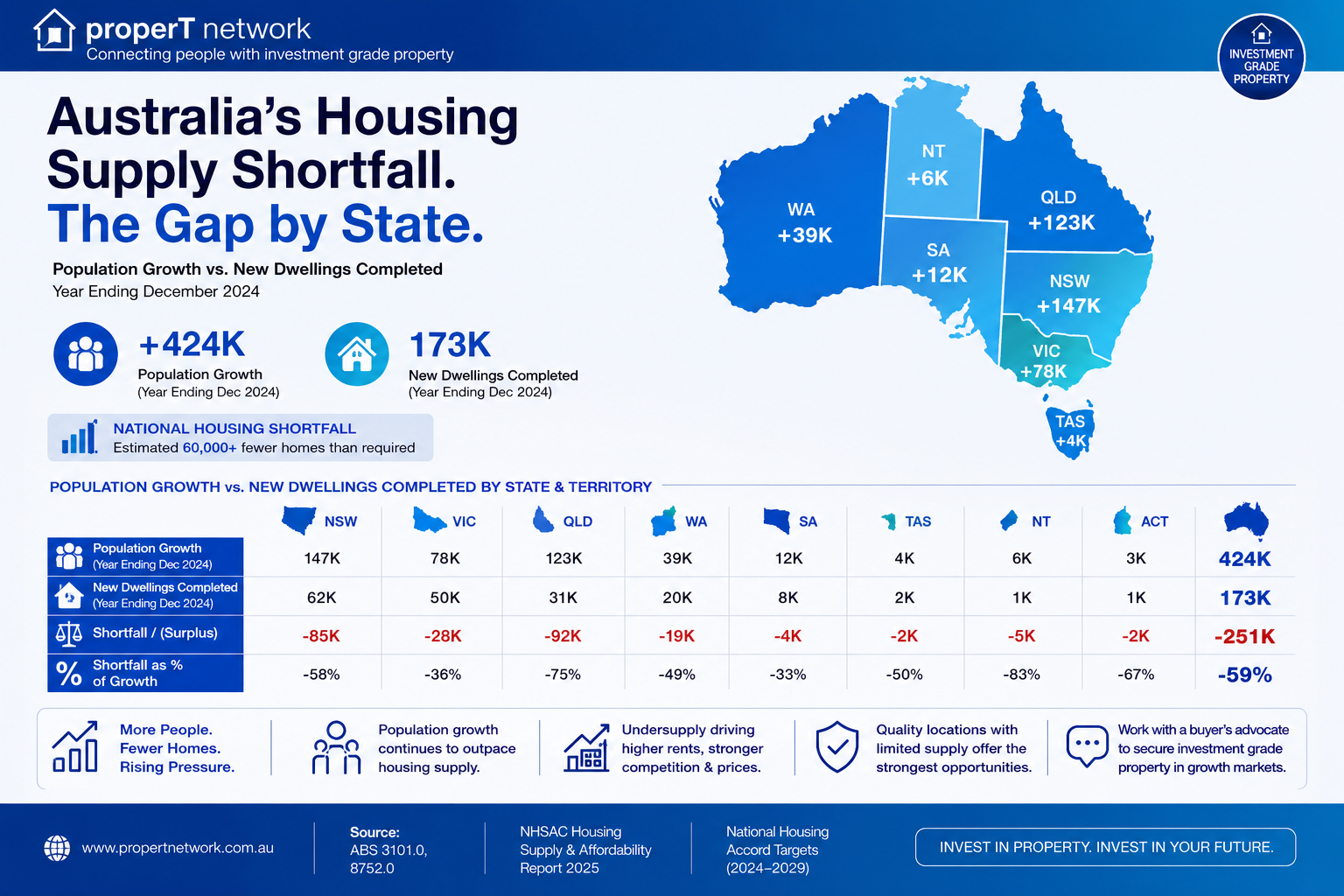
Our infographic below shows how population growth outpaced new dwellings in every state and territory in the year to December 2024, the most recent full-year state comparison available when we built it.
Why Supply Can’t Simply Catch Up
Increasing supply is essential, but the problem runs well beyond approving more developments. The construction sector continues to face:
Trade shortages
Not enough carpenters, electricians, plumbers and bricklayers to build at the pace required.
Builder insolvencies
Record insolvencies in recent years have reduced building capacity and made developers more cautious.
Planning delays
Approvals, environmental assessments and council processes can take years.
Infrastructure
New estates need roads, schools, sewerage, power and transport before homes can follow.
Higher costs
Labour, materials, insurance, finance and development charges have all risen sharply.
Feasibility
Projects that worked a few years ago are now unviable, shrinking the pipeline.
These factors have slowed delivery at exactly the time demand has stayed exceptionally strong.
Demand Continues to Build
Population growth is only one part of the story. Demand is also being supported by:
- Smaller household sizes
- Strong employment
- International students
- Returning expatriates
- Longer life expectancy
- Changing lifestyle preferences
- Interstate migration to more affordable markets such as Queensland and Western Australia
Together they create sustained pressure across much of the country. For a deeper look at the population side, read Australia Population Growth: What It Means for Property Investors.
Why This Shortage Is Different From Previous Cycles
Australia has had housing shortages before, but historically they were cyclical. Rising prices encouraged developers to build, supply caught up, affordability improved and the market rebalanced.
Today’s shortage is increasingly seen as structural. Several long-term constraints are working together, and they can’t be fixed quickly:
Each new household needs accommodation straight away, while a new home can take several years from planning to completion. That timing mismatch keeps upward pressure on both rents and prices. And while the Accord’s goal is commendable, many in the industry believe it can’t be met without major improvements in planning, productivity, skilled labour and infrastructure delivery.
Markets driven by short-term speculation can reverse quickly. Markets supported by genuine shortages of housing, growing populations, limited land and strong employment typically offer more sustainable long-term opportunities.
Why This Matters for Property Investors
Investors should always look beyond the headlines to long-term fundamentals. Housing demand outstripping supply has historically supported stronger rental growth, lower vacancy rates, improving yields, competition for quality property and long-term capital growth.
The rental numbers show it clearly. Cotality data reported by Commonwealth Bank puts the national median rent at a record $705 a week, with renters spending about a third of household income on rent and listings around 17% below the five-year average. We cover this in more detail in Australia’s Rental Crisis Is Getting Worse.
Terry Ryder’s Hotspotting looks for the same signals: depth of demand, tight rental markets, jobs, infrastructure and population growth.
This doesn’t mean every property will perform well.
The best opportunities are usually in investment-grade locations where population growth, employment, infrastructure and limited future supply combine to create sustained demand. That’s why selecting the right property has never mattered more. It’s also why we look closely at supply in growth corridors such as Melton, where demand is strong but so is new construction. Explore our Melbourne and Victorian location research.
The Role of Property Investors
Private investors provide the overwhelming majority of Australia’s rental housing. The ATO’s latest taxation statistics show about 2.34 million Australians own a rental property, most of them just one.
Without them, the rental shortage would be even more severe. Rather than being part of the problem, investors remain an essential part of the housing solution, providing homes for millions of Australians who rent. We make the full case in Is Now a Good Time to Invest in Property?
Rates, Tax and SMSF Changes to Factor In
- Interest rates: the Reserve Bank lifted the cash rate to 4.60% on 29 September 2026, its fourth rise this year. Higher rates add holding costs and reduce borrowing capacity, so any purchase needs to be stress-tested.
- Negative gearing: from 1 July 2027 it will be limited to new builds for properties bought after Budget night. See Budget 2026-27 Negative Gearing explained and the cash flow problem most investors are missing.
- SMSF borrowing: the transition window has now closed. Since 10 August 2026, SMSFs can no longer take out new LRBAs to buy residential property, although existing loans continue and commercial property can still be bought with borrowing. See SMSF Property Investment in 2026: What Has Changed?
A Housing Balance Problem
Australia doesn’t have a migration problem. Nor does it have solely a housing supply problem.
It has a housing balance problem.
Population growth, infrastructure, planning reform and construction all need to move together. Until they do, the imbalance is likely to keep supporting rental markets and quality residential property values across much of Australia.
For investors, the message is clear. Rather than trying to time the market, focus on owning the right investment-grade property in locations supported by long-term economic fundamentals, strong population growth and genuine undersupply. Property markets have short-term fluctuations, but prolonged structural undersupply has historically supported stronger rents, lower vacancies and long-term capital growth.
The right way
- Investor → Strategy → Location → Property
Not
- Property → Suburb → Hope
Is it worthy of your investment dollars?
Own the Right Property in the Right Location
Talk to us about where the shortage is creating genuine opportunity, and which properties we’d avoid. We educate. You decide.
- Mid-Market Property Attracting the Attention of Investors
- Autumn 2026 Property Market Insights and Growth Hotspots
- Apartments Are Gaining Momentum
- The Rise of High-Yield Investment Property Strategies
- Where to Invest in Queensland
- Why I Would Not Invest in a Co-Living Property, and Why I Would
- Rental Guarantees and Co-Living Property Investment
- Australian Bureau of Statistics, National, state and territory population, March 2026
- National Housing Supply and Affordability Council, Quarterly Report, August 2026 and State of the Housing System 2026
- Commonwealth Bank, Rents hit record share of household income (Cotality data)
- Australian Taxation Office, Taxation statistics 2023–24
- Reserve Bank of Australia, Monetary Policy Decision, 29 September 2026
General information only. properT network does not provide personal financial, legal, tax or lending advice. Figures are from the sources and periods stated and may change. Past performance is not a reliable indicator of future performance. Property investment carries risk, including the risk of loss. Seek independent professional advice before making any investment decision.
One Network. Nationwide Reach.
Explore The properT network Family Of Sites

