
Why Ipswich Remains One of Queensland’s Most Compelling Property Investment Markets in 2026
Ipswich Property Market 2026: One of Queensland’s Strongest Growth Stories – But Not Every Suburb Will Perform Equally
For many years, Ipswich was viewed as Brisbane’s affordable western neighbour.
Today, that narrative has changed.
Ipswich has evolved into one of Australia’s fastest-growing urban centres, supported by significant population growth, major infrastructure investment, expanding employment opportunities, and one of the largest housing delivery programs in Queensland.
For property investors, the opportunity remains compelling.
However, as Ipswich enters its next phase of growth, successful investing will increasingly depend on understanding the differences between individual suburbs, housing types, infrastructure corridors, and future supply pipelines.
The days of simply buying “anywhere in Ipswich” and expecting superior results may be behind us.
Why Investors Continue to Watch Ipswich
Located approximately 40 kilometres west of Brisbane, Ipswich occupies a strategic position within South East Queensland.
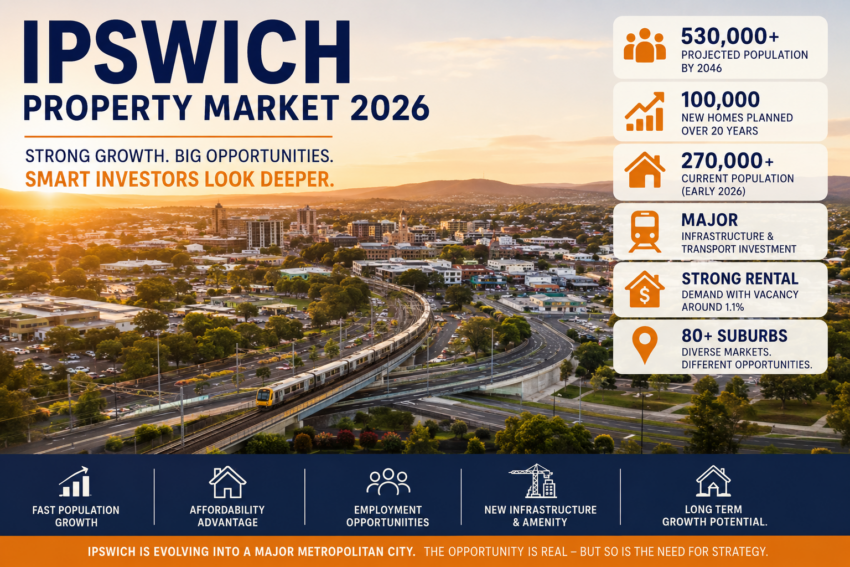
The city covers more than 1,100 square kilometres and consists of around 80 suburbs, ranging from established character precincts through to some of Australia’s largest master-planned communities.
Its connectivity remains one of its strongest advantages.
Ipswich sits at the junction of several major transport corridors, with direct rail access to Brisbane and convenient links to the Port of Brisbane, Brisbane Airport and the Gold Coast.
This accessibility has helped transform Ipswich into a major logistics, industrial and employment hub, while continuing to attract families seeking greater affordability than many Brisbane locations.
Population Growth Continues to Drive Demand
Population growth remains one of the most powerful drivers of long-term property performance.
Ipswich has experienced remarkable growth over the past decade.
In 2016, the city had approximately 200,000 residents.
By the 2021 Census, that number had increased to around 230,000.
Current estimates place the population above 270,000 residents, with projections indicating the city could exceed 530,000 residents by 2046.
That would effectively double the size of the city within two decades.
At current growth rates, Ipswich could surpass 300,000 residents before 2030 and continue expanding strongly throughout the 2030s and beyond.
For investors, this creates an obvious challenge and opportunity: every new resident requires housing.
The Transformation of the Ipswich Property Market
The Ipswich property market has experienced substantial growth since 2020.
What was once considered one of Queensland’s most affordable housing markets has matured significantly.
Median house prices have increased strongly over recent years, supported by population growth, interstate migration, housing shortages and improving infrastructure.
Despite this growth, Ipswich remains considerably more affordable than many Brisbane suburbs, helping maintain demand from owner-occupiers, first-home buyers and investors.
Importantly, affordability continues to be one of Ipswich’s strongest competitive advantages.
As Brisbane prices continue to rise, many buyers are increasingly prepared to move further west in exchange for greater housing value and lifestyle opportunities.
A Rental Market Under Pressure
One of the strongest fundamentals supporting investment in Ipswich is the rental market.
Vacancy rates have remained at historically low levels throughout recent years, reflecting strong population growth and insufficient housing supply.
Rental demand has been fuelled by:
- Interstate migration
- Local population growth
- Limited rental availability
- Rising home ownership costs
- Ongoing housing shortages across South East Queensland
As a result, rents have increased significantly over recent years, providing investors with stronger cash flow outcomes and improved rental yields.
While rental growth is unlikely to continue at the extraordinary pace experienced during recent years, underlying demand remains robust.
The New Ipswich City Plan Changes the Investment Landscape
One of the most important developments for investors is the introduction of the new Ipswich City Plan.
The plan outlines a vision for approximately 100,000 additional dwellings over the next 20 years.
This represents a major shift in how housing will be delivered throughout the city.
Historically, Ipswich has been dominated by detached housing on traditional suburban blocks.
Moving forward, the city will increasingly incorporate:
- Townhouses
- Duplexes
- Secondary dwellings
- Medium-density housing
- Apartment developments
- Mixed-use precincts
The objective is simple.
A city of more than 500,000 people cannot be supported solely by detached housing on large blocks.
As a result, growth will increasingly be concentrated around transport corridors, activity centres, employment hubs and key infrastructure precincts.
What This Means for Property Investors
The introduction of the new City Plan creates both opportunities and considerations.
Some investors view increasing housing supply negatively. The reality is more nuanced.
New housing is essential to support population growth.
Without additional supply, affordability deteriorates, infrastructure becomes strained and economic growth slows.
Master-planned communities such as Greater Springfield and Ripley Valley have played a critical role in accommodating population growth while delivering schools, retail centres, parks, healthcare facilities and employment opportunities.
Many investors have achieved excellent long-term outcomes in these communities.
However, investors should understand that different markets behave differently.
Locations with extensive future land releases may experience periods where supply moderates price growth.
Conversely, established suburbs with limited opportunities for additional housing often benefit from stronger scarcity factors over time. Yet be mindful of new Negative Gearing Budget Stature with existing property.
Neither approach is inherently superior. New property continues to benefit from negative gearing + higher depreciation benefits.
The key is understanding the supply pipeline and matching it to your investment objectives.
Greenfield Estates: Opportunity or Risk?
Some commentators suggest investors should avoid Greenfield estates altogether.
That position is overly simplistic.
New communities can offer significant advantages:
- Modern housing stock
- Strong tenant appeal
- Family-friendly environments
- New infrastructure
- Lower maintenance costs
- Attractive depreciation benefits
- Negative Gearing benefits
Many of Queensland’s strongest-performing locations began as Greenfield developments.
However, investors must also recognise that some estates have large future development pipelines.
Where substantial volumes of similar housing continue to be released, competition between new and resale properties can influence growth rates.
This does not necessarily make these locations poor investments.
It simply means investors need to understand how future supply may affect performance.
The best investment decisions are rarely based on whether a property is new or established.
They are based on supply and demand fundamentals.
Infrastructure Will Shape the Next Decade
Infrastructure investment is one of the major reasons many investors remain optimistic about Ipswich.
Billions of dollars continue to be invested across:
- Road networks
- Schools
- Healthcare facilities
- Public transport
- Employment precincts
- Industrial and logistics hubs
Projects connecting Springfield, Ripley and surrounding growth corridors are expected to reshape how residents move throughout the region.
As the city grows, infrastructure delivery will become increasingly important in supporting property values and liveability.
Understanding Supply Matters More Than Ever
The biggest investment lesson from the new Ipswich City Plan is that investors must think beyond city-wide statistics.
Ipswich is evolving into a significant LGA and is thus not one single market.
It is a collection of distinct markets with different growth drivers.
Questions investors should be asking include:
- Where is future housing supply being concentrated?
- Which suburbs have limited development opportunities?
- Where are major infrastructure projects occurring?
- Which locations offer strong employment access?
- What zoning changes may impact future value?
- Are flood risks present?
- What is the long-term housing mix planned for the area?
The answers to these questions may have a greater impact on future performance than broad city-wide median price movements.
The Long-Term Outlook
The long-term fundamentals supporting Ipswich remain compelling.
Population growth is strong.
Infrastructure investment continues.
Employment opportunities are expanding.
Housing demand remains elevated.
Perhaps most importantly, Ipswich still offers a meaningful affordability advantage compared with many Brisbane locations.
As the city continues evolving into a major metropolitan centre in its own right, investment opportunities are likely to remain abundant.
However, future success will increasingly depend on suburb selection, asset selection and understanding how supply and demand interact at a local level.
For investors willing to do their research, Ipswich continues to present one of South East Queensland’s most compelling long-term growth stories.
Related Property Investment Resources
Budget 2026-27 Negative Gearing explained
Why I would not invest in a Co-Living Property … and or why I would
Rental Guarantees and Co-Living Property Investment
The Rise of High-Yield Investment Property Strategies
Autumn 2026 Property Market Insights and Growth Hotspots
Apartments are gaining momemtum

