
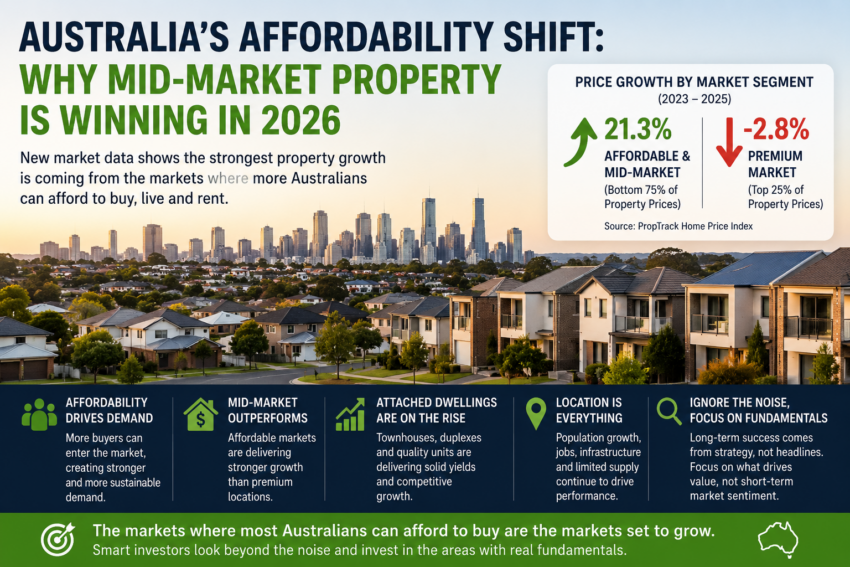
For years, Australian property investors have been conditioned to believe that premium suburbs and blue-chip locations offer the strongest long-term growth.
However, market data from recent years tells a different story.
Across Australia, many of the strongest-performing property markets have not been the most expensive suburbs. Instead, growth has increasingly been concentrated in locations where homes remain affordable for a larger proportion of buyers and renters.
This trend reflects a simple reality: demand follows affordability.
As interest rates, construction costs, living expenses and borrowing constraints continue to impact households, buyers are naturally gravitating toward locations that still represent value. When a greater number of people can afford to purchase in a market, demand remains stronger and more sustainable.
The result is that many affordable regional centres, outer metropolitan corridors and emerging lifestyle markets have recorded stronger growth than some traditionally expensive locations.
Why Affordability Matters
Property markets are ultimately driven by people.
When a suburb or region sits within the financial reach of first-home buyers, investors, upgraders and downsisers, the potential buyer pool is significantly larger. More buyers competing for limited stock places upward pressure on prices.
By comparison, premium markets often rely on a much smaller group of buyers with higher incomes and larger deposits. During periods of economic uncertainty or tighter lending conditions, these markets can experience slower growth simply because fewer people can participate.
This creates an important dynamic for investors.
The properties most Australians can afford are to Buy, often the properties experiencing the strongest demand.
The properties most Australians can afford to Rent, often are the properties with the strongest rental yields.
As an investor “Can you now identify the opportunity?”
The Challenge for First-Home Buyers
Ironically, this trend creates an additional hurdle for aspiring homeowners.
Many government initiatives are designed to improve housing affordability, yet the strongest price growth is often occurring in precisely the markets where first-home buyers are searching.
As affordability-driven demand increases, entry-level properties can become more competitive, pushing prices higher and making it even harder for first-home buyers to secure a foothold in the market.
This is one reason many affordable markets continue to outperform expectations despite ongoing concerns about interest rates and economic conditions.
A first home buyer is well warned to “avoid squeezing the wrong property into their budget!” Entering the market, for the sake of getting a foot onto the property ladder incurs entry to market costs, stamp duties and perhaps a renovation – exiting the purchase once you wish to move on incurs selling costs. Securing your next property once again incurs entry to market costs, stamp duties and perhaps another renovation. This is an expensive exercise … give consideration to being a RentVestor
Why Investors Should Ignore the Noise
Media headlines frequently focus on interest rates, political announcements and predictions of market downturns.
While these factors can influence sentiment in the short term, long-term property performance is still driven by fundamentals:
- Population growth
- Employment opportunities
- Infrastructure investment
- Housing supply shortages
- Rental demand
- Affordability
These drivers continue to support many markets across Australia, particularly those offering relative value compared to neighbouring regions.
Apartments Are No Longer the Poor Cousin of Houses
One of the biggest shifts occurring across Australia’s property market is the growing performance of quality apartments, units and townhouses compared to traditional detached housing.
Historically, many investors automatically favoured houses due to the belief that apartments delivered inferior capital growth. While land remains a key driver of long-term value, recent market data shows that in many cities and regional centres, well-located apartments in lower density apartment blocks and attached dwellings are matching or even outperforming houses.
This trend is largely being driven by affordability.
As house prices continue to rise, many owner-occupiers and investors are finding detached homes increasingly out of reach. Rather than abandoning the market altogether, buyers are turning to quality apartments, boutique unit complexes and townhouses in locations where demand remains strong and supply is constrained.
For investors, this creates an important opportunity.
Waiting several years to save a larger deposit or hoping future borrowing capacity will increase can often prove counterproductive. During that time, property prices may continue rising, meaning the target property becomes even more expensive and requires an even larger deposit.
In many cases, purchasing a quality apartment today can be a smarter strategy than waiting for a house tomorrow.
This approach is particularly relevant for RentVestors. Rather than delaying entry into the market, investors can purchase an affordable investment property within their current budget while continuing to rent in their preferred lifestyle location. This allows them to gain exposure to capital growth, benefit from rental income and begin building equity immediately.
The risk of waiting is that the market moves faster than savings can accumulate. As property values rise, buyers often find themselves chasing a moving target, requiring larger deposits, higher incomes and greater borrowing capacity just to purchase the same property they could have secured years earlier.
Getting onto the property ladder with a well-selected apartment, townhouse or boutique unit can be a powerful stepping stone toward future wealth creation. For many Australians, the first property does not need to be their dream home. It simply needs to be the asset that gets them started.
The Bottom Line
The Australian property market is not moving as one national market.
Instead, growth is increasingly being driven by local fundamentals and affordability.
Investors who focus on population growth, infrastructure spending, employment creation and supply constraints are likely to be better positioned than those reacting to headlines or waiting for perfect certainty.
The evidence suggests that the next wave of growth may not come from Australia’s most expensive suburbs. It may come from the markets where the greatest number of Australians can still afford to buy, live and rent.
Budget 2026-27 Negative Gearing explained
Why I would not invest in a Co-Living Property … and or why I would
Rental Guarantees and Co-Living Property Investment
The Rise of High-Yield Investment Property Strategies
Autumn 2026 Property Market Insights and Growth Hotspots
Apartments are gaining momemtum

